One placebo arm for every season
Every new eczema drug is tested against placebo, and every trial recruits its own placebo patients — often children. A platform trial shares one placebo arm among several drugs. But eczema changes with the seasons: is it fair to compare a drug tested in summer with placebo patients treated in winter?
Born from the forecast
From the view of classic methods: Singularity forecast that platform trials — standard in cancer and in the COVID pandemic — would enter dermatology, where almost no work used them. We asked the question a dermatologist would ask first: do the seasons break the shared placebo arm?
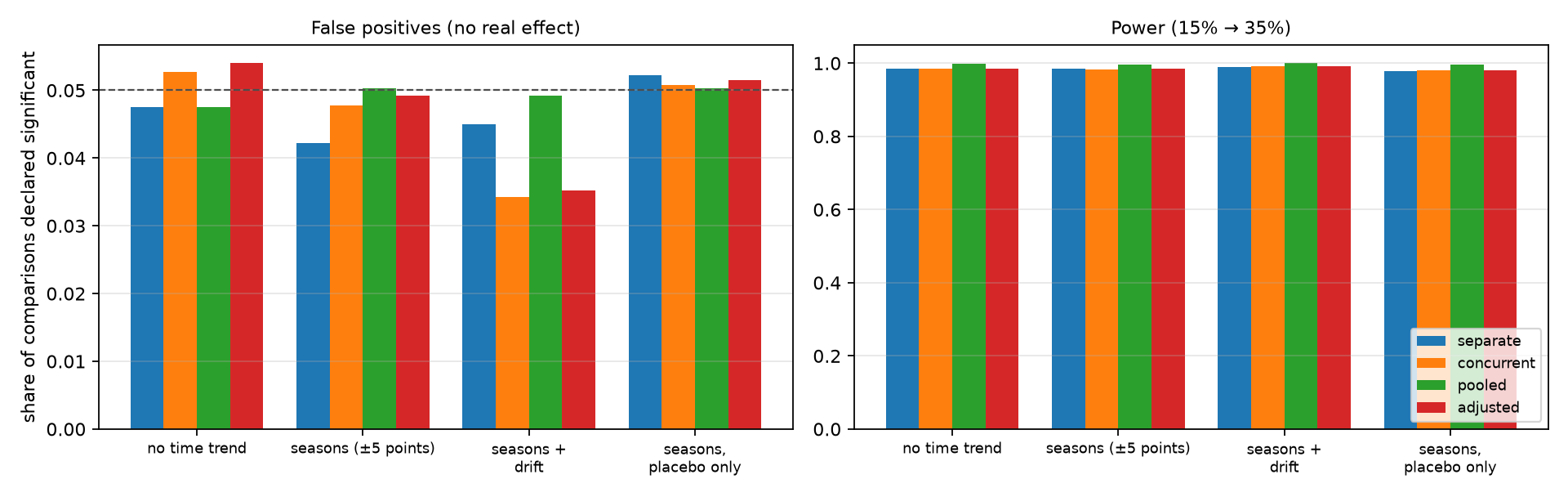
What we found
How we tested it
Simulated platforms with three drugs entering at months 0, 6 and 12, a seasonal swing in response of about five points, a slow drift, and a case where the seasons act on placebo only. Four ways of analysing, 2000 platforms per scenario, fixed before one run.
Why it matters
The seasonal objection to shared placebo arms does not hold in this setting. A dermatology platform can spare patients from placebo without biasing the result — and the same code shows where it would start to fail.
The paper
Sharing a placebo arm across seasons: platform trials for atopic dermatitis, a pre-specified simulation
· November 2026 · preprint
Abstract
Platform trials test several treatments against one shared control arm, and are common in oncology and infectious disease but rare in dermatology. Atopic dermatitis raises a specific concern: disease activity and placebo response vary with the seasons, and comparing a late-entering treatment with controls recruited months earlier may be biased. We simulate a three-arm platform with staggered entry under four time-trend scenarios and compare separate trials, concurrent controls, pooled controls and a period-adjusted model. In 2000 simulated platforms per scenario, the false-positive rate stayed between 3.4% and 5.4% for every analysis in every scenario, and power was 98–100%. The platform needed 378 patients on placebo instead of 450; pooling doubled the controls available to each comparison without measurable bias. The pre-specified effect was large enough to put power near its ceiling, which limits the comparison of efficiency.
Limitations
Large treatment effect, three arms, one entry schedule, one binary endpoint, no interim analyses.