Where science goes next,
before it gets there.
Singularity reads 163 million scientific works from every discipline, learns how methods travel between fields, and names the next crossings — a specific method, a specific subfield, a deadline. Every forecast is timestamped and will be judged against reality.

Millions of papers in · one dated forecast out
Where to work next, in your field.
Methods about to arrive in your subfield — any of 248, across all of science — each with its strength against chance, measured on fifteen years of history.
Open the Radar →How progress really happens.
Five minutes, no formulas — and a game: can you tell which crossings came true?
Start here →What it is, how it works, what it has found.
The evidence, the method without the recipe, and the research it has produced — on one technical sheet.
For partners →Seven million works a year.
No one can read beyond their own field. The method that would crack a problem often already exists — a few departments away, in a language nobody nearby speaks.
Breakthroughs are often translations.
The same story repeats across the history of science: a method matures in one field, then crosses into another and changes it.
Monte Carlo
Born for neutron transport in nuclear physics; became a pillar of option pricing and statistics.
Optimal transport
A problem of moving earth and goods; became the Wasserstein distance of modern machine learning.
Deep learning
Built to recognise images; helped predict the structure of proteins.
?
Watch it happen in the data — one method, field by field, year by year.
The map of science.
All 163 million works we read from OpenAlex, from every discipline, on one map you can explore like a sky: regions for the 252 subfields, the methods placed where they are most typical, the bridges of people between fields and the lines of our forecasts. Zoom in to open single works, travel back in time, type a method to see where it already lives. It works on a phone too.
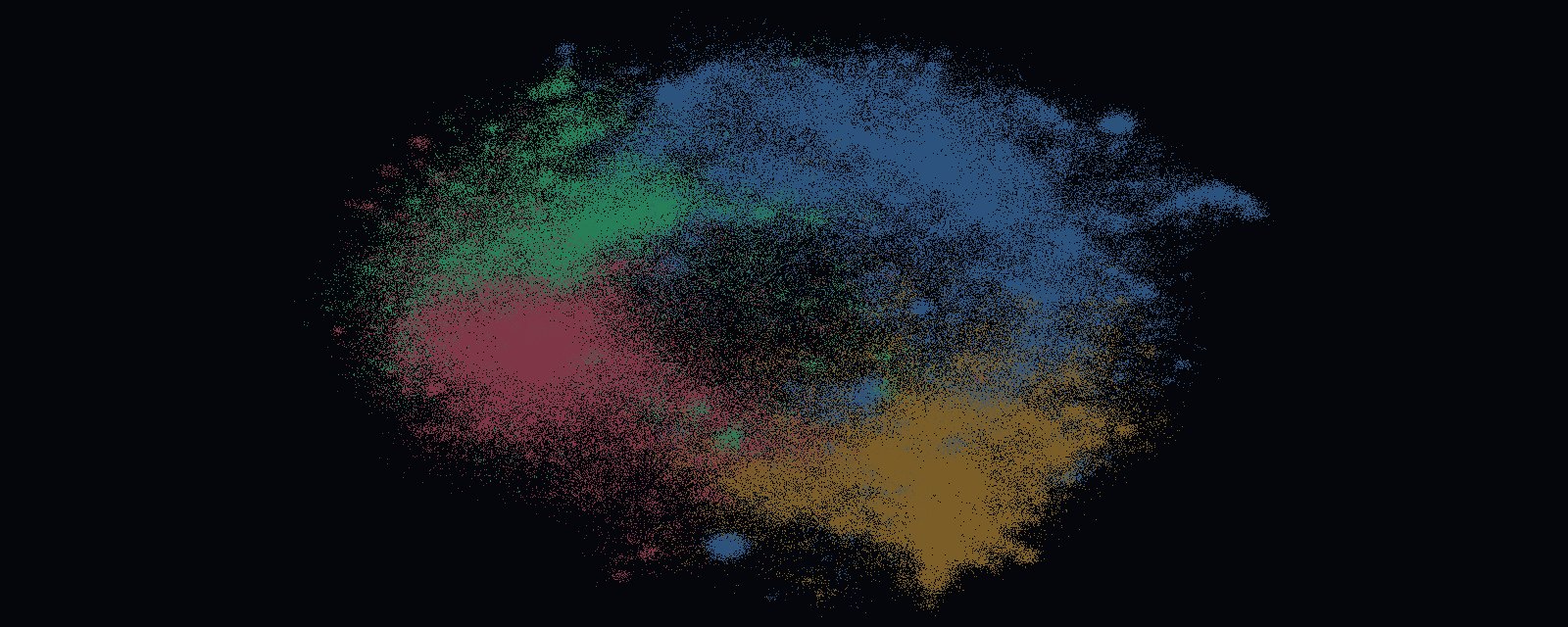 Open the atlas →
Where the next discoveries will come from.
New materials, new medicines, new mathematics: each began, and will begin, as a crossing. For six frontiers, one crossing from history and one the model sees coming now.
“Now” rows are forecasts from the registry of November 5, 2026 — fingerprinted, never edited, judged in 2029 — with the strength against chance measured on backtests for their rank.
Where to work, subfield by subfield
Pick your subfield — any of 248, from oncology to econometrics. The Radar shows the methods most likely to arrive there next, each with its strength against chance, measured on fifteen years of backtests. Shown here: classic methods only, no AI.
Singularity reads the whole record and names the next crossing.
Read
Titles and abstracts of millions of works: which field, which year, which methods.
Map
Which fields resemble each other, where people work across boundaries, what is accelerating.
Forecast
A model trained only on the past ranks every subfield × method crossing — 2.6 million open ones today — by how likely it is to open up.
Verify
Rules written before looking. Forecasts fingerprinted on the day they are made. Outcomes counted years later.
Quadratic unconstrained binary optimization: writing a hard yes/no decision problem as one energy to minimise — the native language of quantum annealers.
works by the end of 2025, adopted in 17 subfields — from quantum physics to computer science and operations research.
works in transportation research — although 37 works next door already use it.
at least three transportation works using it by the end of 2028. Fingerprinted, never edited, judged in 2029.
Tested on the past before being trusted with the future.
Replayed year by year on all of science, seeing only what was known at the time; confirmed on 2017–2022 with rules sealed in advance, then again on 2023. Of the top 100 forecasts on untouched crossings, within three years of each test's data cutoff:
From forecast to discovery.
We took the most promising forecasts, checked whether anyone had done them, and where a real gap existed we ran the experiments ourselves.
Our forecasts are yours to use.
Free for anyone, for any purpose. Turn one into real work — positive or negative — and join the Pioneers: the people who got there first.
Each generation reads more of science.
Every model is judged the same way: freeze the clock at a past year, forecast using only what was known then, and count how many forecasts came true in the following years. Choices are made on development years; the final check is run once, on years never used.
- corpus
- arXiv · 151 fields
- scope
- Physics, mathematics, computer science
- corpus
- 3.2 M papers · 151 fields
- scope
- Same scope, sharper signals
- corpus
- 163 M works · 252 subfields
- scope
- All of science: medicine, biology, chemistry, engineering, social sciences…
The frontier is open.
Every forecast, with the evidence behind it, real papers to read, and a first experiment to try.