Subtypes that are not there
“Three cognitive profiles of ADHD.” “Four subtypes of ageing.” Psychology is full of subtypes found by algorithms. But what do those algorithms say when there are no subtypes at all — only one continuous ability that everybody has more or less of?
Born from the forecast
Singularity forecast that consensus clustering — a method from cancer genomics, where it was learnt the hard way that it can find structure in noise, and was then fixed by testing it against realistic random data — would enter experimental and cognitive psychology, where no work used it. A classic method, a field where nobody uses it. We took the fix with it.
What we found
How we tested it
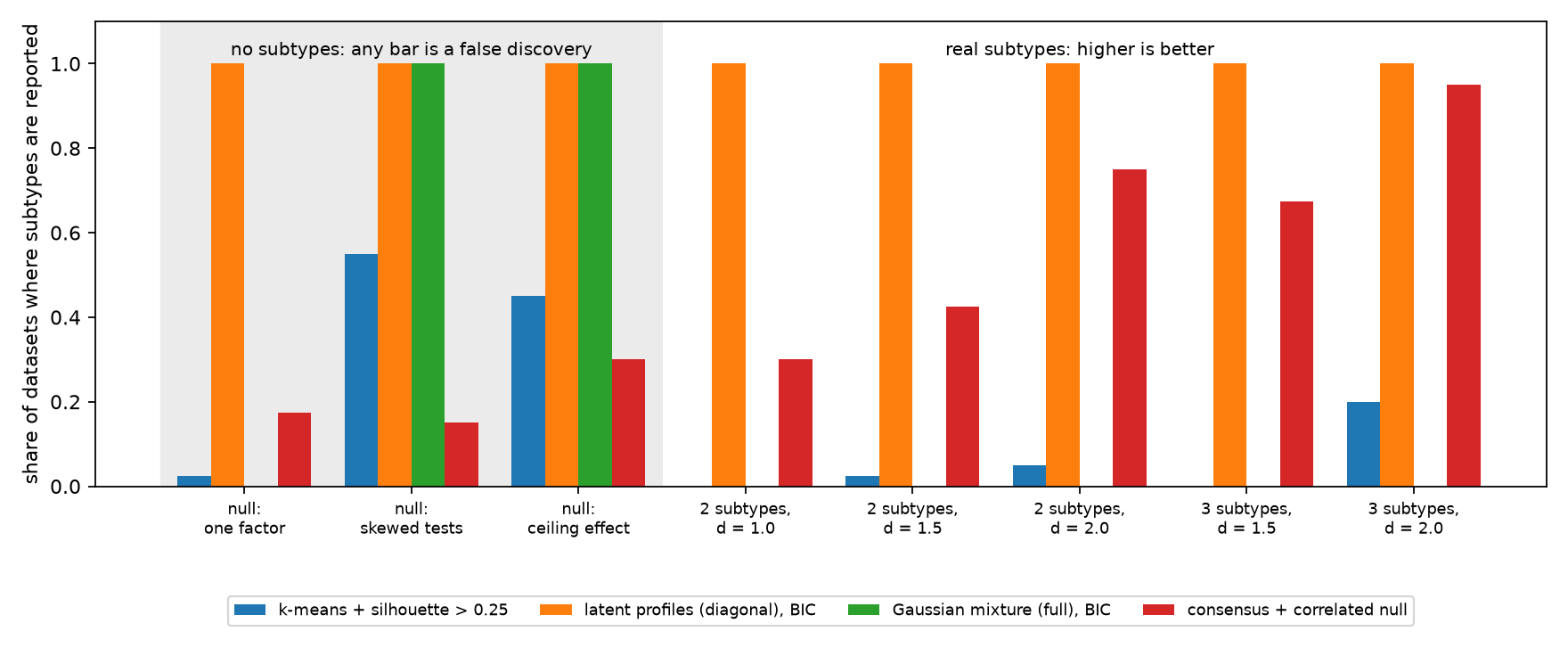
Simulated batteries of 8 tests on 300 people, with a general ability factor; null datasets that are normal, skewed or capped; datasets with two or three real subtypes of growing separation. Four procedures, forty datasets per scenario, everything fixed before one run.
Why it matters
The most common way to count profiles in psychology cannot tell subtypes from a single ability in this setting. A null that keeps the observed correlations is a better default, and the study shows how to make it better still.
The paper
Are cognitive subtypes real? Null-calibrated consensus clustering for test batteries: a simulation study
· November 2026 · preprint
Abstract
Subtyping studies in cognitive and clinical psychology cluster test scores and report profiles. Most cognitive batteries, however, share one general factor, and many scores are skewed or have ceiling effects. We ask how often four procedures report subtypes in simulated batteries that have none, and how often they find subtypes that are there. Latent profile analysis reported subtypes in 100% of datasets, with or without real subtypes. Full-covariance mixtures reported subtypes in 100% of skewed or ceiling-limited null datasets and in none of the datasets with real subtypes. k-means reported false subtypes in 45–55% of non-normal null datasets and found real ones in at most 20%. Consensus clustering calibrated against a correlation-preserving null was the only procedure whose rate differed between the two situations: 15–30% false discoveries, above its nominal 9%, and 30–95% detection.
Limitations
One factor structure, one sample size, equal subtype sizes, ten null references; no real data.