The rare-failure trap
How likely is a bridge, a hull or a turbine blade to fail? Failures are rare, so engineers train machine-learning surrogates on data where failures are artificially multiplied. Does that change the answer?
Born from the forecast
This forecast comes from the view without generative AI: Singularity predicted that SMOTE, a standard trick of machine learning for rare classes, would enter computational mechanics, where almost no work used it. We searched for any measurement of what SMOTE does to the estimated probability of failure — the one number a reliability analysis exists to give — and found none.
What we found
How we tested it
Three standard reliability benchmarks, two kinds of classifier, four strategies, fifty repetitions each, fixed before a single run. The true failure probabilities are known, so every estimate can be checked.
Why it matters
The error changes direction with the number of failures in the training data, which in practice nobody knows in advance. The useful lesson is a rule: a failure probability from a classifier, rebalanced or not, must be checked against the real model before it is trusted.
The paper
Oversampling rare failures: what SMOTE does to surrogate-based failure probabilities
· November 2026 · preprint
Abstract
Classifiers are increasingly used as surrogates of limit-state functions in structural reliability, and because failures are rare they are often trained on data rebalanced with SMOTE. Its effect on the estimated failure probability has not, to our knowledge, been measured. We compare, on three standard benchmarks, a classifier trained on plain Monte Carlo samples, class weighting, SMOTE, and SMOTE followed by a Bayes prior-shift correction, with gradient boosting and a neural network, 50 repetitions each. The direction of the error depends on how many failures the training sample contains: with about nine failures SMOTE overestimates Pf by a median factor of 11–13; with about 57 all strategies are within 0.7–1.2; with about three the plain classifier collapses to 0.00–0.03 of the true value and SMOTE recovers 0.6–0.7 with a very wide spread. No strategy is safe across regimes.
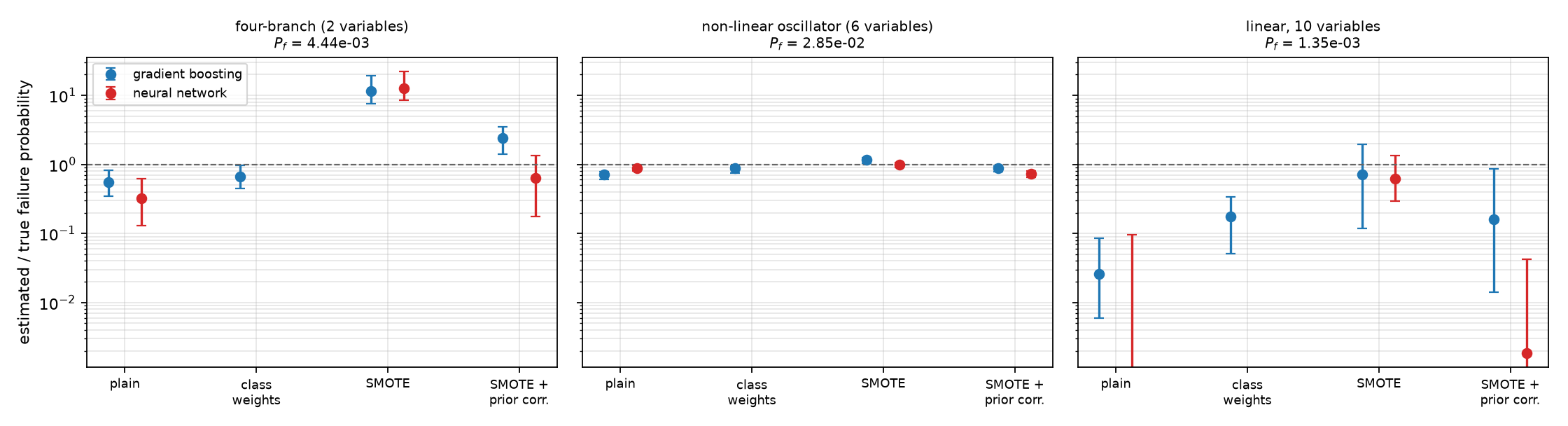
| benchmark | classifier | plain | class weights | SMOTE | SMOTE + correction |
|---|---|---|---|---|---|
| four-branch | boosting | 0.56 | 0.67 | 11.4 | 2.39 |
| neural net | 0.32 | — | 12.8 | 0.63 | |
| oscillator | boosting | 0.72 | 0.88 | 1.17 | 0.88 |
| neural net | 0.88 | — | 0.99 | 0.74 | |
| linear, 10 variables | boosting | 0.03 | 0.17 | 0.71 | 0.16 |
| neural net | 0.00 | — | 0.63 | 0.00 |
Limitations
Three benchmarks, one training size, two classifiers, a 0.5 threshold; adaptive (active-learning) surrogates are not compared.