A learned correction for smoke, almost for free
Films and games simulate smoke on a grid: finer grids look better but cost more time. A neural network can clean up a coarse simulation, but it usually costs more than simply using a finer grid. Can a learned correction be cheap enough to win at the same speed?
Born from the forecast
Singularity forecast that neural operators — networks that learn maps between whole fields in frequency space — would enter computer graphics, where they were still almost absent. We asked the practical question a graphics programmer would ask: does the learned part pay for its own cost?
What we found
Yes, in this setting. The correction is folded into the Fourier transforms the solver already computes for diffusion, so it adds almost no time: eight learned numbers on top of a classical solver.
How we tested it
The criterion, the frozen model and 64 new scenes were fixed in writing before the test. The comparator is the most accurate classical configuration whose time is within 15% of the learned one.
Why it matters
The idea works inside any spectral smoke solver, because the correction lives in transforms the solver needs anyway. Three-dimensional scenes and obstacles are the natural next steps.
The paper
A compact learned Fourier correction for two-dimensional smoke simulation
· November 2026 · preprint
Abstract
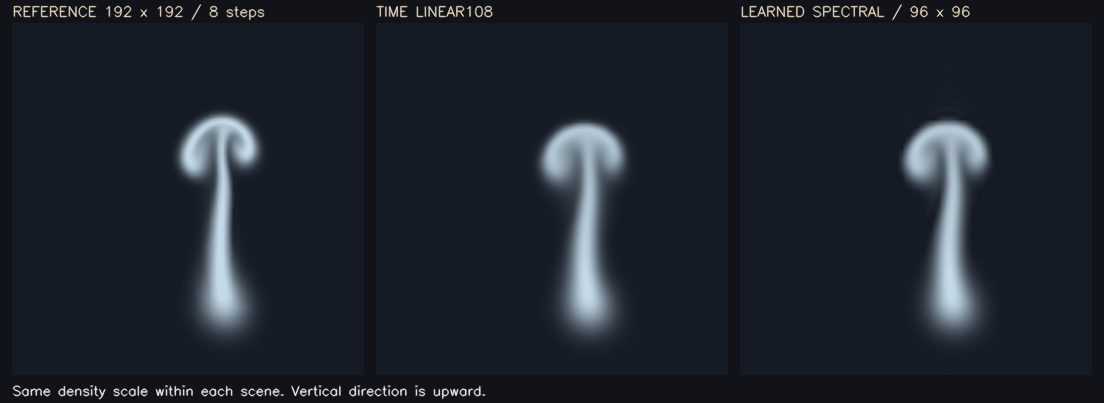
A neural operator placed after a complete smoke solver can cost more than simply using a finer classical grid. We instead fold a learned Fourier correction with eight coefficients into the diffusion transform of a one-step transport solver with a midpoint trajectory. On 64 held-out synthetic smoke scenes the method ran at 0.889 ms per frame on one CPU and reduced mean density error by 8.8% relative to the best classical configuration within the same latency band (0.955 ms), with a paired interval of 4.6 to 13.1%; it improved 49 of 64 scenes and ran 55 times faster than the fine reference. The criterion was fixed before the test. The gain grows with the accuracy of the reference (9.8% against a 256×256 reference on eight predetermined scenes, 3.0% against a coarser 144×144 one), consistent with the correction recovering detail that coarse grids lose. The learned part adds only eight numbers to an existing solver.
Limitations
Synthetic periodic smoke without obstacles, one CPU and 40-frame sequences. The finer primary reference was adopted after a first test against the coarser one failed; the confirming test used new scenes and a frozen model.