Spline layers that tell quarks from gluons
At particle colliders, every jet of particles comes either from a quark or from a gluon, and telling them apart is a daily task. Energy Flow Networks do it with small neural networks. What if those networks used learned curves instead of fixed activations?
Born from the forecast
Singularity forecast that Kolmogorov–Arnold networks — networks built from learned one-dimensional curves — would enter experimental particle physics. Related designs had already been tried on jets; we asked a narrower question: inside the same Energy Flow Network, with the same inputs, are spline layers better than perceptrons?
What we found
They are. The swap keeps the network's physical safety properties and its size, and it separated quark and gluon jets better in a pilot and again at full scale, against a standard network six times larger.
How we tested it
Public simulated jets from two generators. The full-scale test, its comparator and its success criterion were written down before training; the test files were never used for tuning.
Why it matters
It is a cheap change to an established tagger, and it held across two simulators. The next step is detector-level simulation and other tagging tasks.
The paper
Kolmogorov–Arnold layers inside an Energy Flow Network for quark/gluon jet tagging
· November 2026 · preprint
Abstract
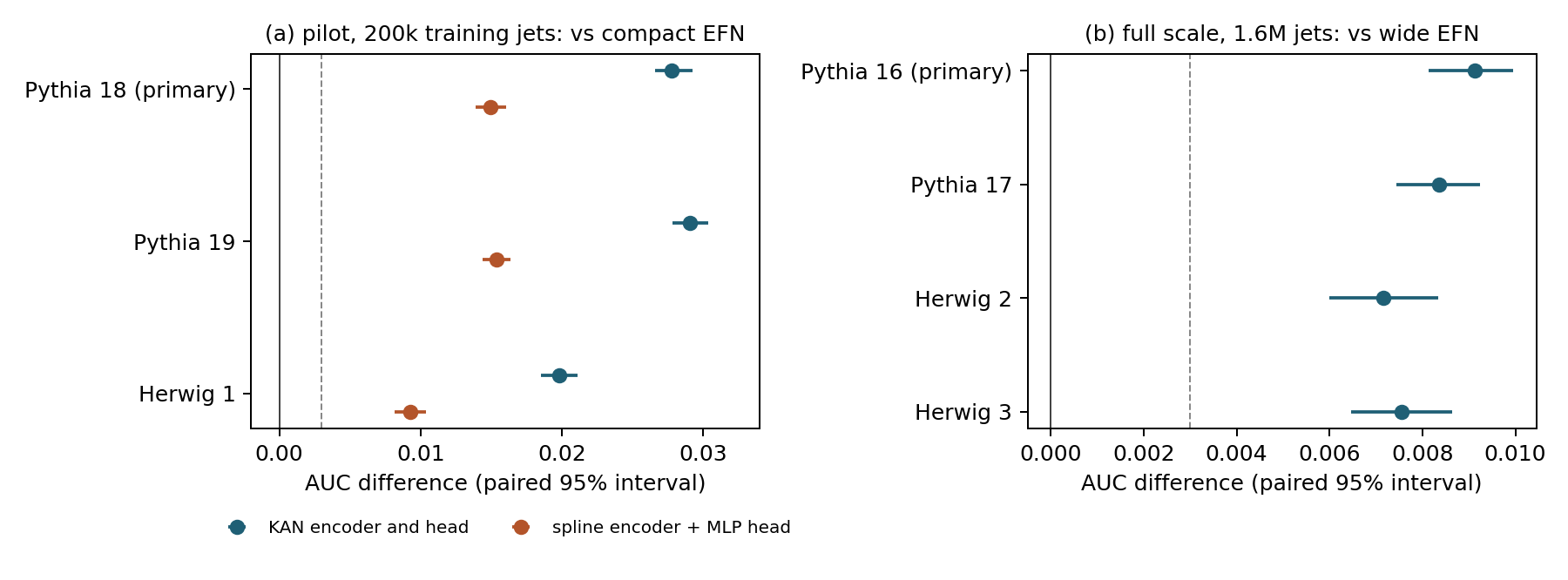
Energy Flow Networks (EFNs) classify jets by summing a learned per-particle function weighted by momentum fraction. We replace the multilayer perceptrons of a compact EFN with Kolmogorov–Arnold (spline) layers, keeping inputs, summation and parameter count fixed, and test it on public simulated light-quark and gluon jets. In a pilot with 200,000 training jets and three seeds, the KAN version raised the test AUC from 0.8306 to 0.8584 (paired 95% interval for the difference +0.0266 to +0.0293), with gains on a second Pythia file and on Herwig jets. A full-scale check, fixed in advance, trained on 1.6 million jets and compared the KAN EFN (2,239 parameters) with a wider standard EFN of 13,025 parameters: the KAN version was still better on the new primary file, AUC 0.8665 against 0.8573 (difference +0.0091, interval +0.0081 to +0.0100), and on all three other test files, including two from a different generator. At 80% quark efficiency the gluon mistag rate fell from 24.9% to 22.6%, with a network six times smaller.
Limitations
Simulated jets in one transverse-momentum range from two generators, without detector effects. The full-scale comparison uses one training run per architecture; in the pilot the KAN was also the more stable across seeds (0.854 to 0.857, against 0.813 to 0.838 for the compact perceptron EFN).