How much the crystal structure is worth
To screen new ceramic materials quickly, models often predict their properties from the chemical formula alone. But atoms can be arranged in different ways. How much does knowing the arrangement help, when the formula itself is new?
Born from the forecast
This forecast comes from the view without generative AI: Singularity predicted that graph neural networks — networks that read a crystal as atoms linked to their neighbours — would enter the subfield of ceramics and composites, where no work used them up to 2025. We measured the gain on perovskites, a central family of functional ceramics.
What we found
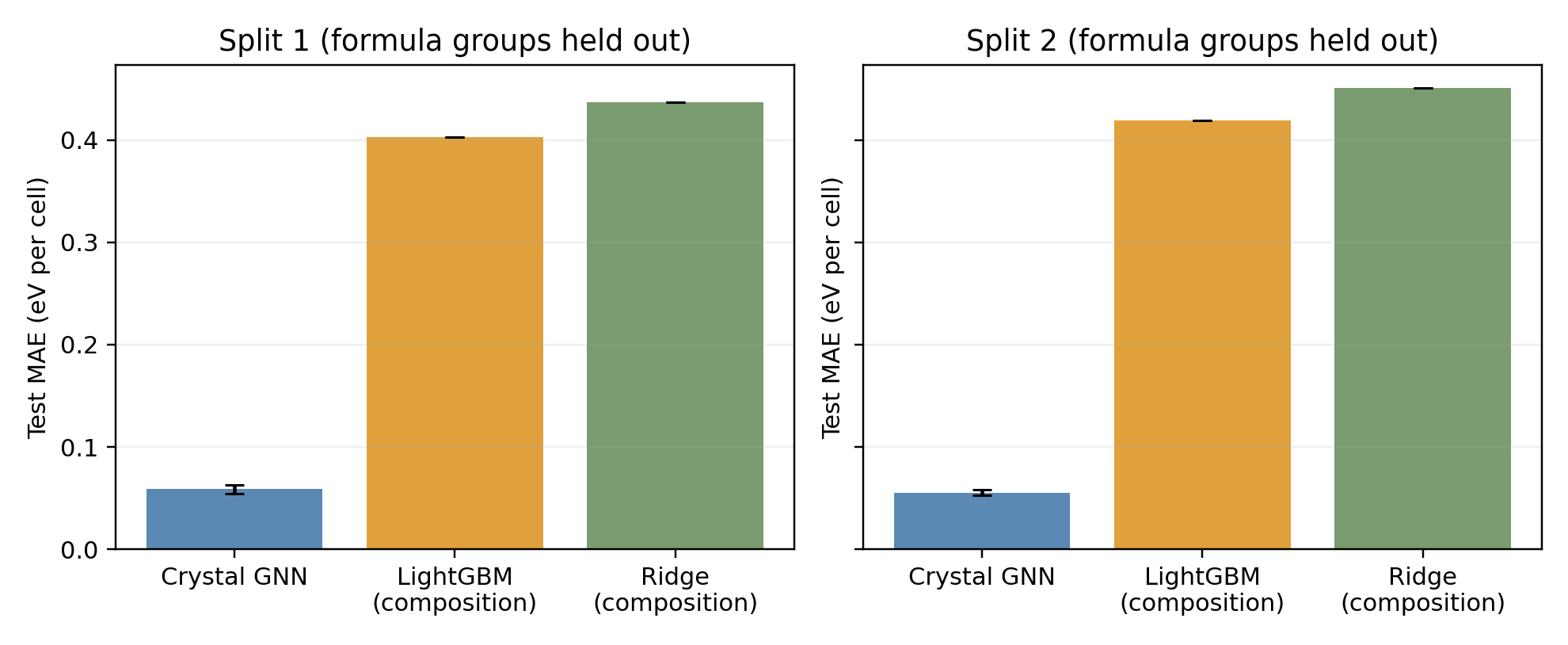
Almost an order of magnitude. On formulas absent from training, a small crystal graph network cut the error of the best composition-only model by about seven times, in two independent splits.
How we tested it
All structures of a formula were kept in the same partition, so every test formula was new. Models, settings and both splits were fixed before the runs.
Why it matters
For screening, this suggests a direction worth testing: feeding even an approximate structure may pay off more than refining a composition-only model. Larger published graph networks are more accurate still.
The paper
Crystal structure versus composition for the formation energy of unseen perovskite formulas
· November 2026 · preprint
Abstract
Composition-only models are a common first screen for new ceramic materials. We measure how much a small crystal graph neural network gains over them when the formulas to be predicted are entirely absent from training. On the Matbench perovskites benchmark (18,928 structures, DFT formation energy), with all structures of a reduced formula kept in one partition, the graph network reached a mean test error of 0.059 and 0.055 eV per unit cell in two independent splits, against 0.403 and 0.419 for LightGBM on elemental fractions and 0.437 and 0.451 for ridge regression. The graph network explained 98.7–98.8% of the variance, LightGBM 47–49%. Paired bootstrap intervals over 1,930 held-out formula groups put the reduction against LightGBM at 0.341 to 0.368 and 0.359 to 0.388 eV. A deliberately small network, trained in about five minutes per seed on a CPU, is enough to obtain this gap.
Limitations
One computational dataset of one materials family, with DFT rather than measured energies. Larger graph networks reported on Matbench reach lower errors; the aim here is the size of the gap, not the best accuracy. The composition baselines use elemental fractions without engineered descriptors.