A few hundred words to sort medical abstracts
Sorting medical texts by condition is routine work for health information systems. Text has tens of thousands of possible words, most irrelevant to any one class. Can a model that keeps only a few of them be both smaller and better?
Born from the forecast
This forecast comes from the view of classic methods: Singularity predicted that LASSO regression, a decades-old way of letting a model switch off useless inputs, would enter health informatics, where no work used it up to 2025. In a first test of ours on clinical tables it barely helped; text is where it has a real job.
What we found
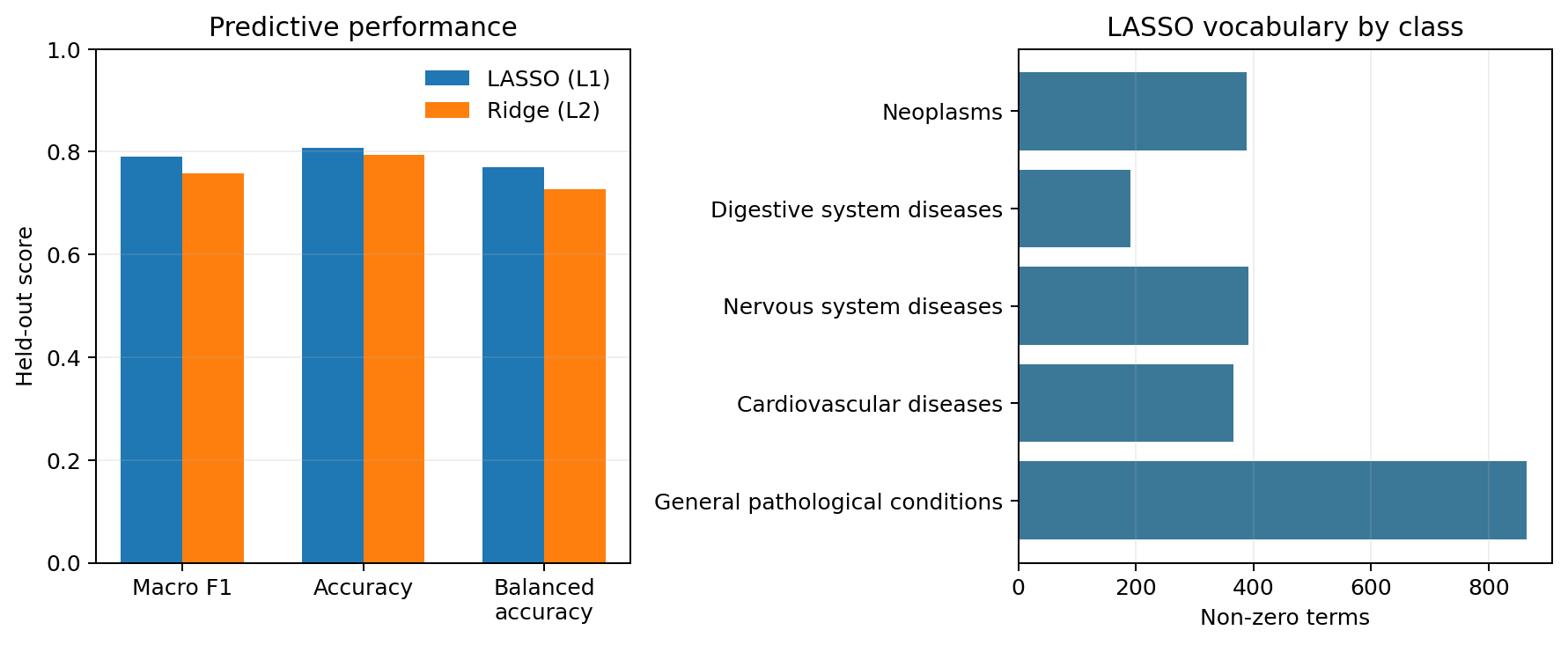
LASSO classified medical abstracts better than the same model without sparsity, while using less than 1% of the possible coefficients. On the way, an audit of the public corpus found hundreds of abstracts repeated between its training and test files.
How we tested it
After removing repeated and conflicting texts, 8,298 unique abstracts were split once; features, models and the tuning grid were written down before modelling.
Why it matters
A compact vocabulary can be read and audited, which matters for clinical text. The same recipe, audit included, applies to other clinical text collections.
The paper
Sparse L1 classification of medical abstracts after removing duplicated and conflicting texts
· November 2026 · preprint
Abstract
We ask whether an L1-penalised (LASSO) linear classifier gives a compact and accurate representation of medical abstracts, a genuinely wide and sparse input. An audit of a public five-class corpus of 14,438 abstracts found 988 normalised texts shared between its supplied training and test files and 2,929 groups of identical texts, all with conflicting labels. Keeping only unique, unambiguous abstracts left 8,298, which we split once (80/20). On the 1,660 held-out abstracts, LASSO reached a macro-F1 of 0.791 against 0.758 for ridge (L2) regression with the same features and tuning; the paired difference was 0.033 (class-stratified bootstrap 95% interval 0.014 to 0.053). LASSO used 2,201 of 250,000 class-specific coefficients (0.9%), a few hundred readable terms per class. Probability ranking was similar (macro AUC 0.952 against 0.956), so the gain lies in the class decisions.
Limitations
One corpus, broad labels and a single holdout. The chosen penalty was at the edge of the tested grid for both models, so a finer grid could change the margin. The selected words are associations with corpus labels, not medical risk factors. Transformer models were not compared.